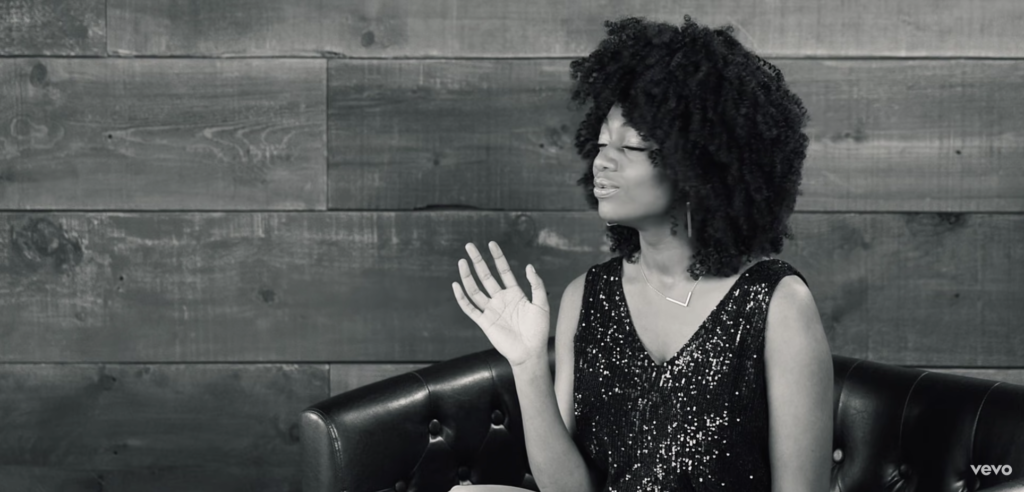
Hailing from the Bronx New York and raised in Philly, Samara Joy’s new career has been catapulting like a rocket ship! As of yesterday, at only 23 years old Samara is now the winner of two Grammy awards: “Best New Artist” and “Best New Jazz Vocal Album” for her latest project “Linger Awhile”.
The singer comes from a legacy of music and a strong background in both Gospel and Jazz. Her paternal grandparents, Elder Goldwire and Ruth McLendon, sang in the famous soul gospel Philadelphia group, The Savettes. Joy’s father is Antonio McLendon, a singer and bassist who toured for years with another gospel star, Andraé Crouch.
In 2020, a viral Facebook video of Joy singng Ella Fitzgerald’s “Take Love Easy” as a thank you for receiving the Ella Fitzgerald Scholarship in 2020 while a student at State University of New York at Purchase led to her receiving a record deal. Her viral video caught the attention of actors like LaKeith Stanfield and Regina King, the latter of whom credits Joy’s music with helping her get through the pandemic.
There are few other ways to describe it. Samara embodies a sound of the past echoing all of the jazz greats from Ella Fitzgerald, Billie Holiday, Sara Vaughan and more. The ArtSoul staff has been following Samara for a couple years now. At first listen, it was clear that she is the future of jazz bringing in both a new younger and older audience of the genre that is quickly becoming enamored by her talent as she re-introduces songs like “Can’t Get Out of This Mood”, “Guess Who I Saw Today”, “Someone To Watch Over Me and More”.
What happens when a 23 year old beauty from the Bronx brings back classic jazz standards? Apparently Tik Tok goes crazy!
In addition to going viral on Facebook where she was originally discovered during the pandemic, Joy has continued to go viral on Instagram and Tik Tok. In addition to growing new listeners to her music, new remixes of Joy’s songs have also been popping up from young Gospel and Jazz fans and musicians such as Producer and YouTube/IG&TikTok sensation Yaahn Hunter Jr who created a Chill Hip Hop infused version of Joy’s single “Can’t Get Out of This Mood” which is still trending on Tik Tok. Listen below…
The video below left many wondering if Samara was lip singing! But, as she has proved live on TikTok from her room and all the way to Paris, France on tour, Samara continues to show us all that she is the real deal!
We are excited to watch Samara Joy’s career continue to thrive as she continues to grow and leave audiences in awe. If you have never seen her live, do yourself a favor and show up to one of the stops on her current tour beginning February 11th through September 11th.
ArtSoul Radio is a 24/7, online Christian Radio Station and Entertainment news site promoting new and diverse sounds in Christian music! We highlight both indie and mainstream artists in Contemporary Gospel, Pop, Soul, Hip-Hop, Alternative, and Spoken Word Poetry.
Robert H. Marshall Jr. does not enter rooms quietly. Not because he is loud, but because the weight of what he carries speaks before he does.
For years, Marshall has emerged as one of the leading voices at the intersection of faith, trauma, masculinity, healing, and identity—doing the difficult work many people preach about but few are willing to confront honestly. As a pastor, author, lecturer, mentor, creative, and advocate, he has dedicated his life to helping boys and men heal from invisible wounds while reclaiming identity, purpose, and hope.
But before the conferences, classrooms, pulpits, documentaries, and books, there was a little boy carrying pain in silence.
Marshall is a survivor of sexual abuse, fatherlessness, abandonment, and childhood trauma—experiences that deeply shaped his understanding of shame, emotional survival, and masculinity. Like many men raised in urban communities, he learned how to perform strength long before he ever learned how to process pain. For years, he hid behind leadership, faith, and achievement while privately wrestling with the emotional aftermath of trauma.
Those experiences became the foundation for his newest book, Shame Is A Liar: Man Enough To Heal, Man Enough To Be Free, a deeply personal and psychologically layered exploration of how shame impacts the minds, relationships, bodies, and spiritual lives of men. The book examines how abuse, violence, rejection, incarceration, addiction, silence, and unhealthy definitions of masculinity distort identity and keep many men emotionally trapped. Marshall challenges readers to confront the lies shame teaches and begin the difficult journey toward healing and freedom.
“Healing is the journey. Wholeness is the destination,” Marshall often says.
His work has resonated far beyond church walls.
Marshall has become a respected voice in faith-based, academic, and social service spaces, lecturing and facilitating conversations on male trauma, restorative justice, mental health, fatherlessness, violence prevention, and emotional wellness through his healing commuities The Survivors Circle & I Am Man, Inc. . As one of the youngest former deans at Moody Bible Institute, he helped mentor and develop emerging leaders while challenging institutions to better understand the emotional and spiritual realities shaping boys, men, and families in urban communities globally.
At the core of Marshall’s work is a sobering belief: that nearly 80–85% of boys and men in urban communities around the world have experienced some form of sexual abuse, trauma, exploitation, or premature exposure to sex. He believes many of society’s deepest crises are rooted in unresolved pain and that more than ever, communities must create intentional frameworks to heal and protect the next generation.
“Broken boys become broken men,” he says. “And broken men often break families, communities, systems, and generations. But if we heal a man, we can heal a family, a community, a nation, and ultimately the world.”
That belief fuels everything he does.
He launched The ARK, one of the first Christian conferences intentionally centered on healing for male survivors of sexual abuse.
“The core of my work is helping people feel safe, seen, and heard,” Marshall says. “I’m committed to becoming what I never had—a safe place.”
Through initiatives, healing circles, conferences, academic spaces, and community partnerships, Marshall works to humanize the lived experiences of survivors, create safe spaces for all people to journey toward wholeness, and empower those who walk alongside survivors to support them well. He strongly believes in diversity and views it as a full reflection of the Kingdom of God—where people from different cultures, backgrounds, stories, and experiences can heal, grow, and belong together.
While much of his work centers on healing boys and men, Marshall also openly identifies as a womanist who believes in empowering women leaders to lead boldly, heal fully, and walk unapologetically in their voice, influence, and calling.
At the heart of his message is faith. Marshall believes healing must move beyond empty religious performance and be rooted in authentic partnership with one another and the Holy Spirit.
Married to his wife Jackie for over a decade, he is the proud father of three children. He sees his life’s work as more than ministry, motivation, or a choice. It’s what God has chosen him to do: to become a conduit of healing in the earth.
Naomi Raine and Chandler Moore have officially announced their exits from Maverick City Music, marking a major shift for one of the most influential worship collectives of the past decade.
The news arrives without scandal or spectacle, but it still carries weight. Maverick City Music didn’t just produce songs — it helped reframe what worship could sound like, look like, and feel like for a generation raised on genre-blending playlists, vulnerability, and authenticity. Naomi and Chandler were central to that identity.
In many ways, the transition had already begun.
Just weeks before the announcement, Naomi Raine released her solo project, Jesus Over Everything, on September 14. The album feels stripped-back and intentional, less focused on communal anthems and more on personal conviction. Songs like “Lost in Hallelujah” lean into restraint rather than climax — worship that doesn’t rush resolution or try to sound bigger than it is.
Addressing the shift directly, Naomi framed the moment as growth rather than departure.
“This isn’t really an ending. It’s a new beginning. A new chapter,” she wrote. “I learned so much about God, about people, and about myself. Every song was written from a pure place — just wanting to please God.”
Her statement reflects a throughline that’s been present throughout her work: faith as something lived and evolving, not fixed or performative.
Chandler Moore followed with his own message, emphasizing clarity and forward momentum rather than nostalgia.
“These last few years have been locked in on what really matters in my life and my career,” he shared. “It’s been scary at times, but full of fresh vision and real excitement about the future.”
That recalibration has increasingly shaped Chandler’s solo direction, which he says is focused less on production and more on connection.
“I’m stepping into the next phase, ready to make music that helps people feel a little more human, a little more understood, and a little less alone.”
That approach mirrors what drew so many listeners to Maverick City Music in the first place. The collective disrupted traditional worship norms by embracing cultural nuance, emotional honesty, and musical hybridity — pulling from gospel, CCM, soul, and contemporary Black music without forcing clean lines between them.
Naomi and Chandler weren’t just contributors to that sound — they helped define it.
Their exits don’t signal an abandonment of that vision so much as an expansion of it. Naomi’s Jesus Over Everything and Chandler’s forthcoming solo work suggest both artists are exploring what faith-centered music looks like when it’s untethered from a single collective framework.
For fans, the moment may feel like the closing of a chapter — but Maverick City Music was always designed as a community, not a container. Its influence was never meant to stop at the group itself.
As Chandler put it plainly:
“The dream hasn’t changed. The sound continues.”
What changes now is scale and direction, not intent.
Naomi Raine and Chandler Moore aren’t leaving behind what they helped build. They’re carrying it forward — on their own terms, in their own voices, and into whatever comes next.
About ArtSoul Radio
ArtSoul Radio is a faith-forward media and culture platform spotlighting the intersection of Christian R&B, Gospel, CHH, and creative expression. Through storytelling, sound, and community, we amplify the voices shaping the next era of faith-driven culture.
Chicago was the backdrop for a moment you couldn’t script any better: GRAMMY®, Dove, and Stellar Award-winning powerhouse Jonathan McReynolds linking arms with American Idol Season 23 winner Jamal Roberts to deliver a live ballad that hits straight to the soul. Their new single, “Still,” isn’t just another worship record—it’s a reminder that God’s love is the one thing that doesn’t shift when life does.
Recorded live in McReynolds’ hometown, the song is lifted from his forthcoming project Closer—an album already carrying heavy anticipation. What unfolds in “Still” is classic Jonathan: heartfelt storytelling, layered with rich theology, now elevated by Roberts’ fresh, unshaken voice.
Jonathan McReynolds has carved out a lane few can touch—an artist who makes Gospel feel as real as your group chat confessions. His catalog has always balanced honesty and worship, bringing Sunday morning depth into everyday playlists.
Enter Jamal Roberts: the new voice America fell in love with on American Idol. His win wasn’t just about vocal ability—it was about heart, authenticity, and the kind of presence that feels rare. Pairing him with McReynolds doesn’t just make sense; it feels prophetic. It’s the kind of intergenerational link-up that keeps Gospel fresh while honoring its roots.
The Vibe
With “Still,” Jonathan McReynolds and Jamal Roberts don’t just give us another Gospel single—they give us a soundtrack for resilience. It’s raw, it’s soulful, and it’s proof that the future of faith-based music is in good hands. Expect this one to be on repeat long after the Stellars.